What will be the Next iPhone?
Everyone seems obsessed with the idea to build the next iPhone. Is it AI related tool? Is it VR helmet? Sam Altman speaks about that, Imran Chaudhri tried to build the AI pin. Many of them wants to be the next Steve Jobs, many of them wants to build the next iPhone. The end goal to find something that will be so awesome, so we will switch immediately, forgot our iPhones in the dusty corner and never returned back.
By the iPhone I mean any smartphone these days, I’m referring to the iPhone here, just because it was the first device in its class.
As a product designer I see the problem here. It’s clearly to me that the next iPhone device should have specific characteristics set that original iPhone had, and that’s the reason why we stick with it and can’t move to the next one that easily for decades. In this short essay I will answer on question why alternatives wasn’t successful and how to build real iPhone killer.
But first we need to see what’s the biggest issue with alternative devices.
Problem with iPhone alternatives
1. Apple Watch as iPhone replacement
Some people tried to replace their iPhones with an Apple Watch Cellular. This seems like a logical move: it always with you, it has cellular connections, it can read Emails, make phone calls, so why not to use it instead of iPhones?
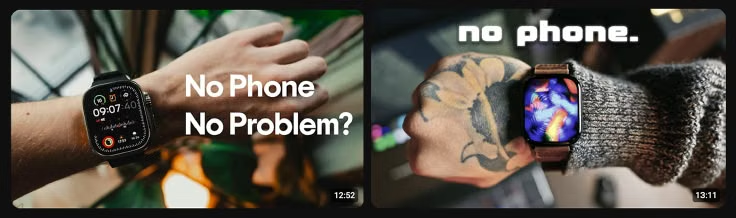
Biggest obvious issues: it has no camera, it has no keyboard that you can type when you can’t speak out loud and it has not a great battery.
The Apple Watch is great as fitness addition to your daily activities: it can track physical body parameters, it can let you do something quickly, like a quick message replay. But what if you’re in simulation that you can’t use your voice to type a message? It has virtual keyboard, but it’s not that comfortable to write long messages. Something short and quick is fine, but not a fully replacement even to iPhone’s virtual keyboard where you can type with two hands.
At the same time iPhone has it all:
- bigger battery that can let you to use device for 1-2 days
- ability to type (almost) well with one or two hands, so it fits well when you need to quickly reply or type work related emails or reports
- voice controlled AI
2. VR helmets as iPhone replacement
The biggest issues: at exact the same moment you put Meta Quest or Apple Vision Pro you cut yourself from the people around.

Another biggest issue: VR motion makes some people feel sick, it applies pressure to your head, applying pressure to forehead and face, neck fatigue and in some cases produces heat. It also requires to carrying a battery, to power the VR well. With Apple Vision Pro you can use it only for about 2-2.5 hours of general use.
VR glasses might have poor battery life (3-4 hours only, compared to iPhone 1-2 days), uncomfortable fit, requirement to wear a bend to control Meta’s RayBan glasses.
Compared to iPhone:
- you can take it out from the pocket situationally: only when you need it. Sometimes it might look rood, yes, but still not cutting you from the community
- battery life is good
- no additional things to put on yourself, like a band, to control the iPhone. Just your fingers
3. AI pin as iPhone replacement
This one seems the worst among others. Top complains about AI pins usually are:
- AI assistant might not be that reliable as ChatGPT app in your iPhone
- Wi-Fi issues or device to server issues, which is critical to the device core functionality
- Loud invorunment can prevent device microphone to take your input well
- In the case of the Humane AI Pin, there are several issues: overheating during short-term use, a low battery, a long AI response time, and the lack of a camera view, which makes it difficult to control what you are taking a photo of.
Why iPhone become a big thing
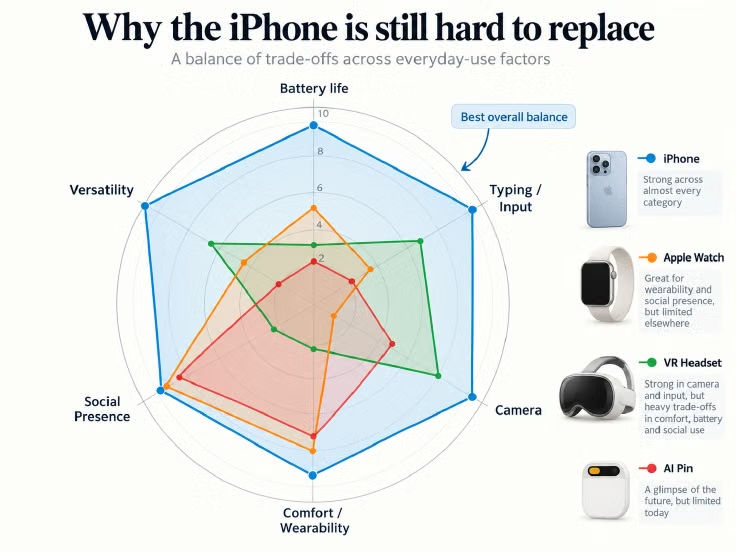
iPhone not an ideal, but somehow by accident or not, the iPhone becomes the device that has less compromise among many-many things. So other devices that promises to kill the iPhone also contains a lot of compromise in return.
Was it just native evolution of an iPod, a genius vision by Steve Jobs or an accident, when you see what modern technology can give you and just just glue it together (display, connectivity, mobility), it doesn’t matter now. What matters is that this approach fits to our lives so well, so it’s hard to change that paradigm without taking out something important.
What will be the real next iPhone replacement?
To beat the iPhone, the real iPhone killer should have most of things that fits our life, and do them better than an iPhone. It should be somehow with us, always there and only when we need it, not to cut us from the reality, but be addition to it.
It should have no compromise on what we already can do with the iPhone today, it should not take, but add something on top of it. If you take something away, then it will be noticeable deflation from our existing experience with the iPhone. If you can’t do something with that new device then you will be always comparing it to your past experience, thinking “but with the iPhone I can do it better”.
I have a feeling that at this moment in our tech development we probably can’t achieve that well without changing the technology behind it.
Let’s compare it with technological change of the past. Let’s say we’re in the middle of XX century, the CTR TVs all around and we badly want that CRT screen to be flat. As much flat as we have it today in our iPhones, MacBooks or LCD TVs. No matter how badly we want it to be flat we’re facing technical limitations: the CRT technology has to have heater, electron beam, magnets, fluorescent screen. Without changing the paradigm of the technology we can’t achieve it flat. We only can try to make it as flat as possible or apply some other tricks (like changing directions of the tube), but it still has its limits.
Imagine an iPhone with small but CRT screen. It’s bulky by the tech limits and now it’s not an iPhone anymore: you can’t put it into your pocket, mobility will be limited.
The same is for the next device to replace the iPhone.
Display. Can we find the new technology to show an image to a human eye without reducing its brightness (currently iPhone 18 pro has 3000 nits), same or a better sharpness, same or a bigger size without carrying out a big box in the pocket? Let’s imagine that we achieved a state with the Neuralink that can product a sharp, bright image, variable in size, sharp and without compromising anything else, including operating time?
Input. Maybe we find the new way to type without using our hands, not making any mistakes, type fast and be able to do that without voice.
Mobility. Battery life is a barrier you can’t ignore. You probably don’t need 2-3 days usage straight, depends on a situation, but at least fully day of usage without limit yourself on a usage and without caring big or heavy reactor.
We can’t predict how technology evolves. With iPhone release we got lucky to have flat displays, decent battery, mobility of the network infrastructure, touch screen technology, so as a mix it was exactly in between of different technologies and our general needs that makes it to happen so well. But for the next iPhone killer we need to have new set of technologies to make a next jump forward.
What’s your take? I’d love to hear it.